Defining the new borders: Part III Students and technology AUPs
My goal in creating this last portion of my three-part AUP of the futureis to avoid the extremes. We all hear about the pendulum of education but here is an attempt to harness the progress that the swinging pendulum makes. After all, the clock doesn’t move without that swinging. The extremes I’m referring to here are equally impractical for different reasons. The extreme that most schools, including my own, tend to lean toward is blocking and banning the outside world. Content filtering, long AUPs that make it clear that the goal is to keep everything “in-house” and insular. Risk-takers need not apply and, if you are here, get ready to pack your bags. The other extreme is what I would call the “let ‘em learn it on their own” side. This camp basically “gives up” on any meaningful filtering and says, “the kids are going to do it anyway”. This is not only defeatist but dangerous. Students do need a filter—their brain and moral compass. And they aren’t going to develop and employ it on their own. So here is my attempt at crafting a technology vision or AUP for students that takes what’s important to both camps and allows for time to march on.
***Student Technology Agreement***
This school district believes that technology is a tool for learning and as a tool for learning schools need to teach proper use of this tool. As with most tools, chainsaws, drills, and lawn mowers for example, safety and proper instruction are important.
Access to technology in this district is like access to a textbook or a pencil or a notebook. They are an important part of classes, but theymust be treated with care.
When you use technology in this district, you agree to follow the rules and procedures listed below:
1. Treat equipment like you would your pet, family member, or video game console. As with any other piece of school equipment, you are responsible to pay for damages to it if they are intentional or careless.
2. You need to show responsibility with your computer, online andoffline. That includes but is not limited to:
a. Understanding the rules of the road and asking teachers when you don’t understand those rules.
b.Don’t share personal information for yourself or others online unless under the direct supervision of a teacher including pictures, addresses, full names, phone numbers.
c. Don’t do things online that you wouldn’t do in person, likename-calling, threatening or harassment.
d. DO NOT try to access websites or programs that are illegal, pornographic, or are not appropriate for school. If you think it might be, ask a teacher. Just because the filter didn’t ban you from it, doesn’t always mean that it is “OK” to go to.
e. Reporting any problems or inappropriate behavior to staff members immediately.
f. DO NOT under ANY circumstances attempt to bypass the school’s security or content filters. If you need to access something with educational value, see a staff member.
To helpsstudents make better choices with technology, you must complete a school-based on-line responsibility course before you will be given a school issued laptop.
Showing posts with label k12online07pc. Show all posts
Showing posts with label k12online07pc. Show all posts
Thursday, November 22, 2007


Wednesday, October 24, 2007
Defining new borders: Part II
In part two of my series on rewriting the AUP (Acceptable Use Policy) of the future, I'm addressing the issue of teacher use of technology with an emphasis on encouraging creativity, risk taking, and exploring. I call it giving teachers "A License to Thrive"
Teachers, think of all of the possibilities that opened up for people with the invention of the car. The ability to travel long distances with ease: vacations, joy riding, drive-thrus, work opportunities. And with those possibilities came some concerns as well: traffic, smog, car crashes, road construction. What if we had not overcome those challenges and abandoned the car many years ago? How well would you do today without a driver's license? How would that limit the way you live your life? In many ways we have asked students to live their academic lives without something that is just as essential to them...technology.
But, you may say, people LEARN to drive. They get tested on the rules of the road, there are penalties for breaking those rules, and there are safety features built in to minimize risk. Technology should be no different... Therefore, here is our school district's technology policy with regard to teachers and students.
Teachers
5 Simple Rules of the Road

Next post "Defining New Borders: Part III... the students."
Photo Credit Flickr User Nerdy Girl
Teachers, think of all of the possibilities that opened up for people with the invention of the car. The ability to travel long distances with ease: vacations, joy riding, drive-thrus, work opportunities. And with those possibilities came some concerns as well: traffic, smog, car crashes, road construction. What if we had not overcome those challenges and abandoned the car many years ago? How well would you do today without a driver's license? How would that limit the way you live your life? In many ways we have asked students to live their academic lives without something that is just as essential to them...technology.
But, you may say, people LEARN to drive. They get tested on the rules of the road, there are penalties for breaking those rules, and there are safety features built in to minimize risk. Technology should be no different... Therefore, here is our school district's technology policy with regard to teachers and students.
Teachers
5 Simple Rules of the Road
- Teachers must obey all (internet) traffic laws. In other words, if it's against the law (in real life, don't do it online).
- Teachers will yield to larger vehicles on the road (parents). If a parent wants to restrict use of their child's information online beyond the restriction's in the school's AUP, you must yield to them and make an acceptable detour for the student.
- Know that even though the car has airbags, you are not invincible. Though our school has a content filter, this does NOT provide foolproof protection. Teacher and parent monitoring is the most effective means of providing for a safe trip.
- You may not always know how to get there, but always know the reason for your trip. No one is expecting you to know where the detours might be, but you should know the general direction your headed in, and be able to explain to students and parents why this is better than walking and worth the gas money.
- In this car, there is no reverse. The likelihood of abandoning technology as a learning tool is about as likely as reverting to horse-n-buggy, slates and cave wall paintings. Every once in awhile we might have to stop for directions, but the fact is, there's still a long way to drive.
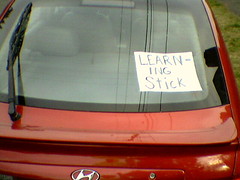
- Driver's Education- Each educator will receive instruction on issues in internet safety including but not limited to
- Content Filter (How it works, How to use it, How and when to remove the roadblock)
- Online ethics (How to conduct yourself online, analyze sources and navigate information).
- Alphabet soup (Teacher's guide to FERPA, CIPA, AUP, C-Copyright and the rest of the alphabet)
- Insurance Policy- This is simply an assurance from the school district that we will support educators in their exploration of technology integration in accordance with our technology vision. We will...
- Support your use of technology tools by providing the tools that you need online and offline.
- We will support your vision by informing the public of the benefits of technology in our school, and how it can be used ethically and safely to benefit students.
- We will provide needs-based, on-going professional development with technology integration and support you in your efforts to explore this area with time, and available resources.
- Test Track- This is a safe, controlled area where you can "kick the tires" and explore technology tools to see if they are beneficial to your classroom. This will be...
- A teacher run group of educators who wish to explore new technology together.
- An environment to encourage risk taking as a group and personal reflection.
- A group that will have the real power to recommend new technologies for education and shape the future technology goals and vision of the the school district.
- Act as a virtual sandbox to test your tools before using them in the classroom or in public.
Next post "Defining New Borders: Part III... the students."
Photo Credit Flickr User Nerdy Girl
Sunday, October 14, 2007
Defining the new borders, Step 1
In the interest of trying to answer the question posted by Dave Warlick in his keynote at the K12 Online Conference (see my previous post) and trying to be proactive in how to extend the borders of my own classroom and school, I'm going to share some thoughts. I haven't deliberated on this a great deal but I think I've got to start somewhere and I welcome comments and criticism.
Several people in the chat reaction to Warlick's keynote cited the need to give teachers some freedom: freedom to explore this new world, freedom to be creative and bold, and most of all, freedom to fail knowing that their head will not roll for doing so. So, what is one of the obstacles that many teachers have to face in order to encourage these changes... The AUP (Acceptable Use Policy) in their schools. I have yet to see an AUP that fosters true exploration and creativity while simultaneously protecting students and the school. A good AUP needs to reassure parents, satisfy the needs of CIPA and FERPA, give teachers the professional control that they need, and the technology administrator (in that order). So, let me take a crack at it.
Assurance to Parents-
Understand that the school is using their best judgement to both keep your child safe and use technologies in a way to best educate your child for a more and more digital, ever-changing world. The school will safeguard information about your child (as outlined below) and you have the right, as a parent/guardian to insist upon more stringent restrictions at any time by contacting the school.
Just a thought... Should I be posting this on a wiki to collaborate with people and add their thought and suggestions? Let me know what you think.

Several people in the chat reaction to Warlick's keynote cited the need to give teachers some freedom: freedom to explore this new world, freedom to be creative and bold, and most of all, freedom to fail knowing that their head will not roll for doing so. So, what is one of the obstacles that many teachers have to face in order to encourage these changes... The AUP (Acceptable Use Policy) in their schools. I have yet to see an AUP that fosters true exploration and creativity while simultaneously protecting students and the school. A good AUP needs to reassure parents, satisfy the needs of CIPA and FERPA, give teachers the professional control that they need, and the technology administrator (in that order). So, let me take a crack at it.
Assurance to Parents-
Understand that the school is using their best judgement to both keep your child safe and use technologies in a way to best educate your child for a more and more digital, ever-changing world. The school will safeguard information about your child (as outlined below) and you have the right, as a parent/guardian to insist upon more stringent restrictions at any time by contacting the school.
- Student personal information (full name, grades, medical information, social security information, telephone numbers or addresses) will not be shared with anyone outside of the school without your permission.
- The school will instruct students in internet safety and appropriate online behavior.
- The school will offer you, the parent or guardian an online safety course, free of charge, once a semester or on a continual basis as the need arises and technologies change.
- The school will maintain an informational website for parents to access if they are unable to attend the school online safety course that gives students and parents tips on online safety.
- Teachers will notify you if they intend to use photos or video of your child on a website accessible to the general public in which they are identifiable and, after contacting the teacher to share your concerns, you will have the chance to restrict your child's image from being used. At that time an appropriate alternative will be implemented.
- Internet access at school will be filtered to try to block content that is profane, lewd, illegal, or pornographic. However, no content filter is 100% effective at blocking everything and we feel that the education of you and your child, as well as monitoring of a teacher are the best way to keep students from accessing these sites.
- Decisions about other web tools, sites and computer programs are left largely to the discretion of the educator, and any concerns or questions you may have about tools or materials used during class should be directed initially to the child's teacher, then to school administration.
Just a thought... Should I be posting this on a wiki to collaborate with people and add their thought and suggestions? Let me know what you think.
Friday, October 12, 2007
Reflections on ACTEM's MainED '07
I went to ACTEM's annual computer technology conference for educators yesterday and I'm always amazed at how many "experts" there are among educators. It seems that every year there are more and more presentations put on by teachers and in some cases their students as well. It seems like there were fewer "sales pitch" kinds of sessions so kudos to the organizers.
 I didn't come away from the MainEducation conference with any specific set of skills that I didn't know how to do before, but I did come out, as always, refocused and feeling supported. In the rural school in which I teach I may be one of a handful of teachers who has even heard the term "Web 2.0" for example, and I often feel the need to connect with others who are starting to truly understand why education needs to change and who are legitimately interested in the question of how it needs to change.
I do, however get frustrated when I think of the obstacles in place, for me and my district, that make this kind of change harder. I don't share these obstacles to put a damper on the conversation or to shirk my responsibility, I do so to hopefully enlist help from anyone would care to give it. I am going to do my best, within my own district to try to positively cultivate the changes I think need to happen in order to better serve our students.
So here's a list of obstacles... (bear with me through the negative parts).

I do, however get frustrated when I think of the obstacles in place, for me and my district, that make this kind of change harder. I don't share these obstacles to put a damper on the conversation or to shirk my responsibility, I do so to hopefully enlist help from anyone would care to give it. I am going to do my best, within my own district to try to positively cultivate the changes I think need to happen in order to better serve our students.
So here's a list of obstacles... (bear with me through the negative parts).
- Our filter, and more importantly the philosophy behind the way it is being used. Students and staff are routinely blocked from valuable sites and tools that would greatly benefit learning. I have been blocked from wikis, podcasts, blogs, video and image sites and many more in the past. This is not to say that we need every site unblocked (that would be impractical and inappropriate). But it is, nonetheless, an obstacle for teachers to overcome.
- The idea that all student and staff creation, publication and information remain on our own server and in our control. A few years ago, I was blocked from my own website, which, at the time was only an easy way to update class links and information because, as I was told by my then principal, "The school has a website and server and work for education has to be housed there, not on your personal space." When I asked if I could only bring in newspaper articles, videos and books that were approved specifically by the district I was told that I was just trying to be negative.
- Restriction of technologies to limit activities not related to work. More and more often I here the argument that staff in particular would simply squander their time on their laptops on E-bay, ESPN, and other sites for personal use. I don't think anyone would agree that school is an appropriate place to run your side business or update your MySpace page, but is tightening the screws on everyone the answer? If a teacher was playing solitaire outside of the technology realm and failing to meet the needs of their students, wouldn't that be just as concerning? Why don't administrators deal with these people individually and not use technology restrictions as a means to increase productivity.
- Isolation or lack of support of teachers who want to take risks, be creative and try new things. Most teachers will tell you that trying something new in your classroom is a risk you take alone. Teachers have to learn to band together, to build communities to support each other, and to build an effective educational argument for the lifting of these restrictions. Administrators need to embrace these staff members and work closely with them to support their work and help them think of the possible pros and cons of what they are doing. Teachers need to "sell" their underlying instructional beliefs of a project to the school, not just complain that a particular piece of technology has been restricted.
I found this particular piece of advice offered by David Warlick in his response to the K12-Online Conference chat about his keynote presentation:
"at the same time that we need to be taking down traditional boundaries and creating more boundaries for new traction, setting walls for the safety of our children remains paramount. ..and this is a much bigger problem than that. It's not just a technical problem that can be solved technically. But that said, the problem that I see is in erecting those walls so far from the classroom. I think that we should respect the classroom teacher as the instructional leader of their domain, and give teachers the ability to open those walls up in times that are appropriate. If a teacher selects a resource, that they have evaluated, and then find that the web page is blocked, they should be able to open it up for their class appropriately, not appeal through channels to someone who has no vocational interest in instruction.
Dave's point here is well made. We can't just flick a switch and fix it. It's far too complex for that. I hope in following posts to be able to start proactively surmounting these obstacles in this forum and maybe even chronicling my efforts in real life.
I hope to get some much needed advice and support, so PLEASE comment and offer suggestions.
Photo Credit: www.actem.org
I hope to get some much needed advice and support, so PLEASE comment and offer suggestions.
Photo Credit: www.actem.org
Technorati Tags: ACTEM DavidWarlick MainEducation07 k12online07pc k12online07 Maine Education Technology
Tuesday, October 9, 2007
Dave Warlick's K12Online Preconference Keynote
I have just finished viewing Dave Warlick's pre-conference keynote (you can too by clicking the video link here).
Here are some thoughts.
When hear Dave and many other people discuss the future of education, with or without a technology focus, I'm reminded of myself as a student in high school physics trying to grasp the concept of acceleration. Acceleration is a measurement that doesn't describe speed, as some students, including myself thought. It wasn't about how fast you are going in miles per hour or meters per second. It's actually a measure of the RATE OF CHANGE. I think that is what Dave Warlick is describing when he mentions being part of the last generation of young adults who, when looking at their parents, could see that as their future as well. I think that is what he is illustrating when he reviews the all important meter stick of 20th century information model-- the encyclopedia.

I think the central question in education for today and the future then becomes not "What can you learn?" but "How quickly do you learn something else?" In order to answer that question, I think students and teachers really need to know themselves as learners, inside and out. They need to know how to compare new knowledge and experiences with one's they've had before and see where the fundamental similarities and differences are. They also need to know how to sift through the scenery on this information superhighway to look for the sign posts that really matter to their journey.
When traveling on any journey your acceleration is totally useless without VELOCITY. Velocity does involve speed, but more importantly DIRECTION. If students and teachers are to be sucessful in the future, we need to be know what direction we are traveling in, be able to adjust if there's a detour, and not be scared to end up in the breakdown lane or get lost once in a while.
Dave outlines three convergences on education's future.
1. Info Savvy Students
2. New Informational Landscape
3. Unpredictable Future
If teachers are going to cope with these factors, they MUST be encouraged to take risks, explore, reflect, and LEARN. As a high school teacher, I know that most of my fellow colleagues are more content to avoid risks, better know the current patch of grass they've been standing on, and often times blame the students for not "getting it right the first time". Sadly, when looking around to see what our schools have to offer teachers who are willing to take these risks, the list is pretty short. Our district does offer support for professional development (conferences, coursework, and the occasional one day in school department meeting for curriculum development). However, for most teachers who want to try something new in their classroom, "You are on your own." Sadly the only time most teachers get recognized for trying something new and innovative in their classrooms is when they are spoken to about covering the curriculum or disturbing the technology department with requests to unblock sites.
What can schools and communities do to encourage students and teacher to accelerate their own learning, reflect on where they've been and plot a new course?
I have some ideas, but I'd like you hear yours as well.
Flickr Photo Credit
Here are some thoughts.
When hear Dave and many other people discuss the future of education, with or without a technology focus, I'm reminded of myself as a student in high school physics trying to grasp the concept of acceleration. Acceleration is a measurement that doesn't describe speed, as some students, including myself thought. It wasn't about how fast you are going in miles per hour or meters per second. It's actually a measure of the RATE OF CHANGE. I think that is what Dave Warlick is describing when he mentions being part of the last generation of young adults who, when looking at their parents, could see that as their future as well. I think that is what he is illustrating when he reviews the all important meter stick of 20th century information model-- the encyclopedia.

I think the central question in education for today and the future then becomes not "What can you learn?" but "How quickly do you learn something else?" In order to answer that question, I think students and teachers really need to know themselves as learners, inside and out. They need to know how to compare new knowledge and experiences with one's they've had before and see where the fundamental similarities and differences are. They also need to know how to sift through the scenery on this information superhighway to look for the sign posts that really matter to their journey.
When traveling on any journey your acceleration is totally useless without VELOCITY. Velocity does involve speed, but more importantly DIRECTION. If students and teachers are to be sucessful in the future, we need to be know what direction we are traveling in, be able to adjust if there's a detour, and not be scared to end up in the breakdown lane or get lost once in a while.
Dave outlines three convergences on education's future.
1. Info Savvy Students
2. New Informational Landscape
3. Unpredictable Future
If teachers are going to cope with these factors, they MUST be encouraged to take risks, explore, reflect, and LEARN. As a high school teacher, I know that most of my fellow colleagues are more content to avoid risks, better know the current patch of grass they've been standing on, and often times blame the students for not "getting it right the first time". Sadly, when looking around to see what our schools have to offer teachers who are willing to take these risks, the list is pretty short. Our district does offer support for professional development (conferences, coursework, and the occasional one day in school department meeting for curriculum development). However, for most teachers who want to try something new in their classroom, "You are on your own." Sadly the only time most teachers get recognized for trying something new and innovative in their classrooms is when they are spoken to about covering the curriculum or disturbing the technology department with requests to unblock sites.
What can schools and communities do to encourage students and teacher to accelerate their own learning, reflect on where they've been and plot a new course?
I have some ideas, but I'd like you hear yours as well.
Flickr Photo Credit
Technorati Tags: k12online07pc
Subscribe to:
Posts (Atom)


